Sunday, Jun 7, 2026 | What If I Can't Believe?

What If I Can't Believe?
Julie Pennington-Russell

In this service, Pastor Julie begins a new series, Honest to God — three sermons for anyone who's tired of pretending when it comes to faith. The first is called What If I Can't Believe?

The philosopher Paul Tillich once wrote that doubt is not the opposite of faith — it is an element of it. The father in Mark 9 could have told him so. His son has suffered for years. The disciples couldn't help. And when Jesus finally comes down the mountain, this man says something that is less a confession than a cry: I believe; help my unbelief. He does not pretend. He does not perform certainty he doesn't have. He just stays — and says the truest thing he knows.

The accompanying text from Colossians 3:12–17 adds a surprising counterweight: a community clothed in compassion, bearing with one another, letting peace rule. Faith, it turns out, is rarely a solo act. We hold it together when none of us can hold it alone.

In this service, we will also share communion and receive a collection for our benevolence fund.
Sunday, May 31, 2026 | Aware and Amazed

Aware and Amazed
Julie Pennington-Russell

The poet Mary Oliver believed that paying attention was a form of prayer. The writer of Psalm 8 would have agreed. O Lord, our Lord, how majestic is your name in all the earth. The psalm begins and ends in wonder — but in between, the poet looks up at the moon and stars and asks something that sounds almost like despair: What are human beings, that you are mindful of them? It is the question of someone genuinely astonished by the scale of things, unsure where they fit.

In this service, Pastor Julie preaches the recovery of a posture from Psalm 8. Head back. Eyes open. Breath caught. The accompanying texts set the frame: Genesis, where God steps back again and again to call creation good; and Matthew, where the risen Jesus sends his followers into the world in the name of the one who is somehow Father, Son, and Spirit at once.

We live in an age of more information and less awe than almost any before us. Something has gone numb. Wonder, it turns out, is less about what we know than how we attend — and together we'll ask what it might take to get it back. The accompanying scriptures are Genesis 1:1–2:4 and Matthew 28:16–20.

Sunday, May 24, 2026 | Where the Breath Goes | Eric Mathis

Where the Breath Goes
Eric Mathis

In this service, Pastor Eric preaches on Pentecost Sunday with a message titled "Where the Breath Goes," drawn from John 20:19-23.

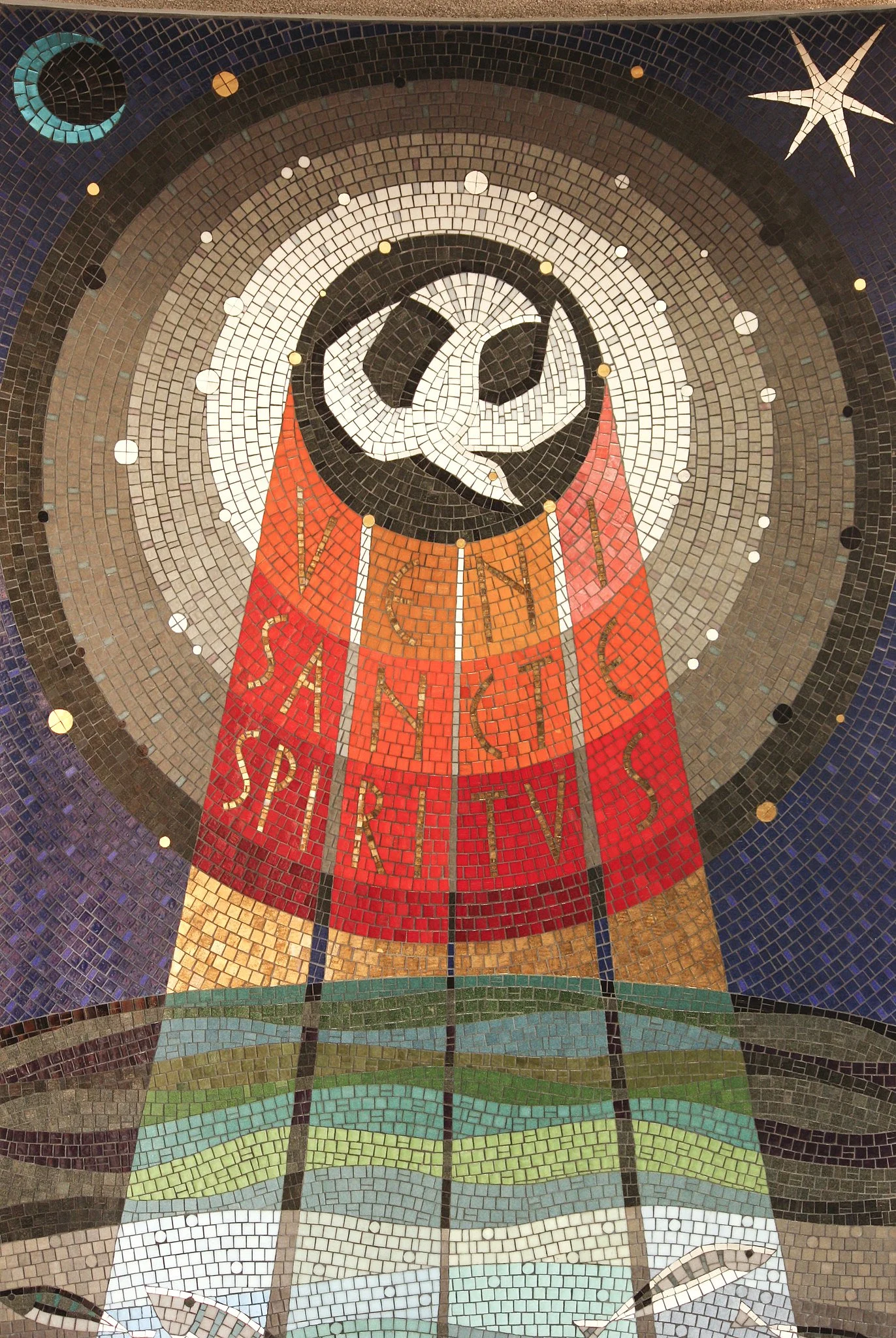
Kossowski, Adam. Veni Sancti Spiritus, from Art in the Christian Tradition, a project of the Vanderbilt Divinity Library, Nashville, TN. [retrieved May 19, 2026]. Used with permission.

Most of us come to Pentecost through Acts 2 — the violent rush of wind, the divided tongues of fire, the city bewildered and Peter preaching to thousands. It is a loud, public, unmistakable arrival.

But John gives us a different Pentecost entirely, and it may be the one our moment most needs. The doors are locked — not as a failure of courage, but as an honest account of what fear does to people after the world has come apart. Into that room, Jesus comes. He speaks peace before he speaks commission. He shows his wounds before they rejoice. And then he breathes — the same word John's Greek shares with Genesis, when God breathed life into the dust of the earth.

This is new creation happening in a locked room. The Spirit, it turns out, doesn't wait for open doors or ready hearts. It goes where the breath goes — into the closed places, the wounded ones, the rooms we've sealed against the world. Accompanying scripture passages are Acts 2:1-21 and Psalm 104:24-34, 35b.

Sunday, May 17, 2026 | Joyful, Anyway | Pastor Eric

Joyful, Anyway
Eric Mathis

In this service, Pastor Eric preaches on Ascension Sunday with a message titled "Joyful, Anyway," drawn from Luke 24:44–53 (and yes, the title is borrowed from Kate Bowler's latest book). What do you do with the ache of absence? Most of us know it well — the moment something precious disappears, something we couldn't imagine living without, and the world shifts under our feet.

The disciples knew it too. They had just watched Jesus ascend into the sky, and what they were left with was space — wide, uncharted, a little terrifying. But here's what's strange: Luke says they returned to Jerusalem with great joy. Not grim determination. Not making the best of things. Joy. It may be that the absence created something — room for purpose, space to become who they had been made to be, an opening for the work only they could now do.

Kate Bowler has taught us that joy doesn't wait for circumstances to improve. Luke teaches us that joy comes from comprehension — minds opened, purpose clarified, blessing received. It was the kind of joy that ache, strangely, makes possible. Durable, grounded joy. The kind that lasts. Accompanying scripture passages are Psalm 47 and Ephesians 1:15–23.

Sunday, May 10, 2026 | Still Singing

Still Singing
Julie Pennington-Russell

In this service, Pastor Julie completes the Easter series, Still — The Ongoing Life of Resurrection, with a message titled "Still Singing," drawn from Acts 16:16-34.

Beaten, chained, and locked in the deepest part of the prison — Paul and Silas sang. There is a resurrection song in us that the world cannot silence. Fear is a powerful jailer. The Spirit is a better locksmith.

Accompanying scripture passages are Psalm 66:8-20 and Luke 8:26-39.

Sunday, May 3, 2026 | Still Listening

Still Listening
Julie Pennington-Russell

In this service, Pastor Julie continues the Easter series, Still — The Ongoing Life of Resurrection, with a message titled "Still Listening," drawn from Acts 16:9-15.

There was no blueprint. No strategic plan. Just a vision in the night and a group of believers learning to follow the Spirit's lead. What if that's still how it works? A reflection on discernment, obedience, and the surprising places the Spirit leads us.

Accompanying scripture passages are Psalm 31:1-5, 15-16 and Mark 10:46-52. We also partake in communion together, and collect our first Sunday benevolence offering.

Sunday, Apr 26, 2026 | Still Becoming

Still Becoming
Julie Pennington-Russell

Today, Pastor Julie continues our Easter series, Still — The Ongoing Life of Resurrection, with a message titled "Still Becoming," drawn from Acts 9:10-19.

Frederick Buechner said we all hunger to be known in our full humanness—and fear it just as much. The early church discovered that resurrection community is where we finally risk being seen. Join us today and meet two people who never should have trusted each other, learning to call each other friend.

Accompanying scripture passages this week are Psalm 23 and Luke 10:1-9.

Sunday, Apr 19, 2026 | Still Falling

Still Falling
Julie Pennington-Russell

In this service, Pastor Julie continues our Easter series, Still — The Ongoing Life of Resurrection, drawing on Acts 9:1-9.

Saul of Tarsus was traveling with complete confidence in the wrong direction. The Risen Christ had other plans. A reflection on what it means to be undone—and what becomes possible when certainty gives way.

Accompanying scripture passages are Psalm 116:1-4, 12-19 & Luke 9:57-62.

Sunday, Apr 12, 2026 | Still Burning

Still Burning
Julie Pennington-Russell

Easter didn't end. In this service we begin the new sermon series STILL: The Ongoing Life of Resurrection — a five-week journey with the first followers of Jesus as they discover that resurrection isn't a moment to remember but a life to enter. Through dusty roads and strangers at the table, through Spirit-led detours and unexpected encounters, we'll walk together into the ongoing movement of new life. The Resurrection is not finished with us yet.

We open on the road to Emmaus (Luke 24:13–35). Two heartbroken disciples are certain the story is over — until a stranger falls into step beside them and everything begins to shift. Join us as we explore what it means to recognize the Risen Christ in unexpected places, and how resurrection has a way of making itself known in the breaking of bread.

The accompanying scripture passages are Psalm 16 and 1 Peter 1:3–9.

Sunday, Apr 5, 2026 | The Good News Swallows Death | EASTER

The Good News Swallows Death
Julie Pennington-Russell

Happy Easter! This Sunday in worship, we celebrate Christ's resurrection with baptism, the flowered cross, choir, organ, and brass, communion, and a message of hope from Pastor Julie.Pastor Julie will conclude the Lenten sermon series with The Good News Swallows Death, based on 1 Corinthians 15:20-22, 51-57 (with Matthew 28:1-10).This Sunday in worship, we make space for the good news that swallows death. However you arrive—steeped in grief, stunned in disbelief, or running toward hope—resurrection is for you.

Friday, Apr 3, 2026 | Good Friday: A Service of Silence and Shadows

Service of Shadows
Julie Pennington-Russell

Sunday, Mar 29, 2026 | Palm Sunday | The Good News Embraces Great Love and Great Suffering

The Good News Embraces Great Love and Great Suffering
Julie Pennington-Russell

Today Pastor Julie preaches the sixth message in the Lenten series Tell Me Something Good with a sermon from Luke 19:28-44. The crowd is singing. Branches are waving. And Jesus is crying. He sits on a hillside above Jerusalem and weeps over a city that cannot recognize the peace standing right in front of it.
 

There’s a kind of seeing that only happens with eyes that have done their crying. If we linger long enough to grieve with Jesus over what matters in this world, we may begin to see the one love in the world that can transform us. The one love that can change the world.
 

Additional Text: Zechariah 9:9-10.

Sunday, Mar 22, 2026 | The Good News Embraces Both Justice and Mercy

The Good News Embraces Both Justice and Mercy
Julie Pennington-Russell

Fifth Sunday in Lent
John 8:2-11

This Sunday, Pastor Julie preaches the fifth sermon in the series Tell Me Something Good, drawing from John 8:2-11. A woman is dragged into the Temple courtyard. The religious leaders have set a perfect trap: whatever Jesus does, he loses. She's not the concern, she's the setup.

Jesus kneels and writes in the dirt. When he stands: Let anyone among you who is without sin be the first to throw a stone. One by one, the crowd fades away. He offers the woman neither lecture nor condemnation…only a question, and a word of release.

Rules without mercy become instruments of control. Mercy without justice becomes an excuse to look away. Jesus refuses both traps. The good news refuses to choose. Justice and mercy belong together.

Additional Text: Zechariah 9:9-10

Sunday, Mar 15, 2026 | The Good News Emerges from the Margins

The Good News Emerges from the Margins
Eric Mathis

Fourth Sunday in Lent
Matthew 19:13-15

This Sunday, March 15, Pastor Eric preaches the fourth sermon in the series Tell Me Something Good with a sermon titled "The Good News Emerges from the Margins," drawing from Matthew 19:13-15.

Parents are bringing their children to Jesus. The disciples turn them away.

It seems like a minor interruption — children pressing into the crowd, parents hoping for a moment of blessing, disciples doing crowd control. But in Jesus' world, this is not a minor moment. Children occupied one of the lowest rungs of the social order. They were, in the most literal sense, marginal. And the disciples, following the logic of their world, push them right back to the margins where they belong.

Jesus rebukes the disciples and opens his arms.

"Let the little children come to me," he says, "for the reign of the heavens belongs to such as these."

The margins he is talking about are not only far away. They are the margins of war and displacement — the refugee children in our prayers, the families caught in conflicts most of us only glimpse in headlines. But they are also closer: the margins of loneliness, of not belonging, of wondering whether you still matter. The margins that many of us carry quietly into the sanctuary on a Sunday morning.

Which raises a question worth sitting with: what if worship on Sunday morning is itself  a margin? What if our church — an in-between space, where the world's metrics of power and performance lose their grip — is exactly where Jesus already is?

The good news doesn't emerge despite the margins. It emerges from them. It always has.

Additional scripture reading: Deuteronomy 24:17-22

Sunday, Mar 8, 2026 | The Good News Defies Our Calculations

**There were audio problems with the stream - audio drops every 40sec or so for 3 sec. Apologies.

The Good News Defies Our Calculations
Julie Pennington-Russell

Today, March 8, Pastor Julie continues the series Tell Me Something Good with a sermon titled “The Good News Defies Our Calculations,” drawing from the feeding of the five thousand in Mark 6:30-44.

Five loaves. Two fish. Five thousand people. The disciples do the math, and the math doesn't work.

When Jesus tells them, "You give them something to eat," they can only see what they don't have — the limitations, the logistics, the sheer impossibility of the task. But Jesus isn't deterred by the disciples' calculations. He takes what little they have, gives thanks, and breaks it open. And somehow — in ways that defy the arithmetic — everyone is fed.

Jesus models a way of being together that turns scarcity into sufficiency: come together, share what you have, trust the multiplication.

The good news is, everyone gets fed.

Additional scripture reading: Isaiah 55:6-13

Sunday, Mar 1, 2026 | The Good News Embodies Love for God and Neighbor

The Good News Embodies Love for God and Neighbor
Julie Pennington-Russell

Second Sunday in Lent
Luke 7:36-50

March 1, Pastor Julie continues the series Tell Me Something Good with a sermon titled "The Good News Embodies Love for God and Neighbor," drawing from the story of the woman with the alabaster jar in Luke 7:36-50. We will also celebrate Communion together in worship, followed by our church potluck, where we'll also celebrate Pastor Julie's milestone anniversaries.

When a woman from the city slips into Simon's home and kneels at Jesus' feet, weeping and anointing him with costly oil, the Pharisees see a scandal. Jesus sees something else entirely: great love. And in a quiet, subversive moment, he turns to his host and asks him to truly look at her—to see not what she has done wrong, but what she has done right that Simon himself failed to do.

This is the shape of the Greatest Commandment made flesh. Love God with everything you are. Love your neighbor as yourself. And here, in an act that crosses every social boundary, Jesus shows us that these two loves are not separate. They are one.

So this Sunday, as we gather around the table for Communion and then share a meal together at the potluck, perhaps we carry a question with us: Where am I being invited to love more extravagantly? Who in my path is waiting to be truly seen?

The good news is that love this lavish—poured out like perfume, given without reserve—is exactly what the world is waiting for.

Additional text: Isaiah 58:6-12

Sunday, Feb 22, 2026 | The Good News Catches Us By Surprise

The Good News Catches Us by Surprise
Julie Pennington-Russell

First Sunday in Lent | John 2:1-11

This Sunday, February 22, we begin our Lenten journey as Pastor Julie launches the new series "Tell Me Something Good" with a sermon titled The Good News Catches Us by Surprise, drawing from the story of the Wedding at Cana in John 2:1-11.

Wine. Weddings. Laughter. It's an unusual place to begin Lent.

But John's Gospel doesn't open Jesus' ministry with forty days in the wilderness. It opens with a party—a wedding banquet running dry—and a miracle performed seemingly for no other reason than to keep the joy going. Fine wine, saved for last, poured out in abundance when everyone expected the celebration to wind down.

This is the good news Jesus embodies: better than we bargained for, more generous than we calculated, arriving precisely when we assumed it had run out.

Throughout this Lenten season, we'll discover that the good news is genuinely good—joyful, subversive, and wonderfully unsettling. Like a mustard seed that becomes an unruly, magnificent tree, it refuses to stay small or contained. It has a way of upending our assumptions, expanding our imaginations, and catching us off guard.

So what do you expect from Lent? Somber reflection? Quiet endurance? Perhaps the good news has something more in store. The best wine has been saved for last. God's love is so good it will never run dry.

Additional scripture reading: Genesis 18:1-9.

Wednesday, Feb 18, 2026 | Ash Wednesday Worship

Meditation (Ash Wednesday)
Julie Pennington-Russell

Sunday, Feb 15, 2026 | A Christ-Soaked Witness

A Christ-Soaked Witness
Julie Pennington-Russell

We gather for Transfiguration Sunday as Pastor Julie preaches the last sermon in the current series on "A Christ-Soaked Witness," drawing from Matthew 5:13-20.

Salt and light. Two simple metaphors that describe the Christian witness. Salt preserves and flavors. Light illuminates and guides. Both work quietly, permeating their surroundings, making everything around them different by their mere presence.

Jesus doesn't call us to be sugar—artificially sweet. He calls us to be salt—bringing out the best flavors in others, preserving what's good, making people thirsty for something more. What does a Christ-soaked witness look like in a world hungry for authenticity and desperate for hope?

Additional scripture readings include Isaiah 58:1-9a and 1 Corinthians 2:1-12.

Sunday, Feb 8, 2026 | A Christ-Soaked Contradiction

A Christ-Soaked Contradiction
Julie Pennington-Russell

The Beatitudes turn our assumptions upside down. Blessed are the poor in spirit. Blessed are those who mourn. Blessed are the meek. Jesus describes a Christ-soaked life that looks nothing like what power promises or what culture celebrates.

These aren't requirements for blessing—they're descriptions of reality in God's upside-down economy. What changes when we stop trying to earn God's favor and start recognizing where divine presence already dwells? Today we'll explore how the Beatitudes reveal what it means to live fully immersed in God's transforming love.

Additional scripture texts are Micah 6:1-8 and 1 Corinthians 1:18-31.