Charles Cates: On Gratitude

On Gratitude Sunday, November 17, Charles Cates gave a testimony on gratitude.

Charles Cates

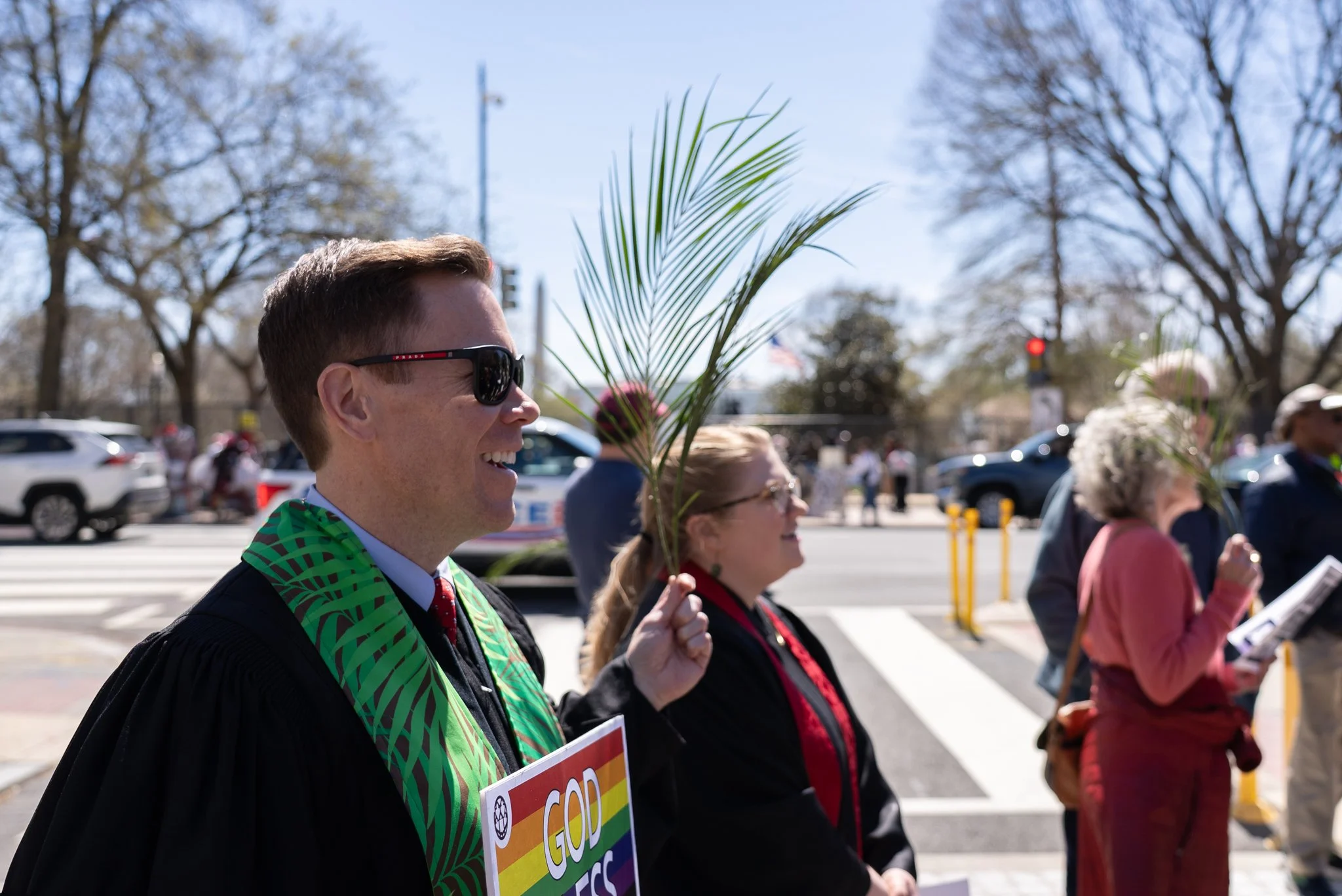
Two weeks ago, about 50 or so members of our congregation stood outside along 16th street in a candlelight vigil holding signs that said things like “Praying for Hope”, “Praying for Peace”, and “Praying for Love”. We came inside and continued with a prayer service where we read scripture and sang hymns together. Why do I bring this up on Gratitude Sunday? I’ll get back to that.

First, I want to say that in this season, our family is grateful for our much more accessible new building. Have you been over and seen it for yourself yet? It is beautiful, and even better, it is beautifully designed to allow anyone and everyone the ability to participate anywhere in the building. The elevator runs from the parking garage all the way up to the balcony, stopping at all of the half floors along the way. That goal of the renovations of creating an accessible design that is welcoming to all was a great success, and everyone in our community here benefits from it. It is a physical testament to our congregation’s commitment to being a place where, as the tagline says, “You Belong” and I am grateful for it.

In this season, I am grateful for the Wonder Years class. Since we started it earlier this year with a book study of Brian McLaren’s Faith After Doubt, I’ve gotten to know some of you on a much deeper level, I’ve grown, I’ve learned, and I’ve felt supported, validated, and loved. Sales pitch – we just started a new book, How the Bible Actually Works by Pete Enns, feel free to come and join us. I am grateful for, and really look forward to our authentic discussions on Sunday mornings as we talk through our thoughts on the book and what’s happening on our own journeys. We Belong, and I am grateful for it.

In this season, our family is grateful for the team who work with our children and youth, who are down in the beautiful and accessible fellowship hall right now leading our children and youth in a special worship time just for them. Our children, Howie, Rosie, and Gwen all look forward to these times, thoughtfully designed just for them, a testament to our congregation’s commitment to supporting children, youth, and families. They Belong, and I am grateful for it.

If someone asked me why do we bring my children to church (I mean it can be hard to get them up and out the door on a Sunday morning) my answer would be that I want them to have a place where they know they are a part of something bigger than themselves, where there are roots that run deep, where their questions can be explored, and where there are people who love and care about them.

So in this season, our family is grateful for a church that believes in welcoming everyone in a building that is open and accessible to all. Our family is grateful for friendships and belonging as we look for God in our every days. Our family is grateful for a place where our children are supported and loved as they learn about God and grow into the incredible people they surely will become.

Jump back with me to that evening two weeks ago, I looked around this sanctuary as we sang Great is Thy Faithfulness and I realized that no matter what happens, the sorrows, the joys, the anxieties, the peace, that these are the people who have chosen to stand on the side of hope, peace, and love, these are the people who we will be standing with, and they are the ones who will be standing with us.

In this season, our family is grateful for you. Thanks be to God.

Clayton Carmon: On Hope

Clayton Carmon

In October, Pastor Julie preached the sermon series Faith, Hope, and Love: These Three. Conrad Johnson, Clayton Carmon, and Pastor Eric shared their testimonies on faith, hope, and love, respectively. In recent weeks, we have reprinted these testimonies for your reading and reflection.

On October 20, Clayton Carmon shared what Faith means to him. You can read his words below, and by continuing onto the website.

“I must admit that speaking about hope intimidates me.”

I must admit that speaking about hope intimidates me. Hope is a thing that we all feel or interact with almost daily. It’s a word we throw around without thought, it’s a sentiment we share with others in times of trouble and triumph. I know for me at least; I allow myself hope at the start of every college football season that this might be the year my Aggies win the championship. Alas, that remains just a hope.

When I was growing up, I knew at quite an early age what hope was. Raised in a Southern Baptist church, I knew that my hope was Jesus, that the promises of God fulfilled in the sacrifice and subsequent resurrection of his son was hope incarnate, hope for me and hope for the world, and as such, it was all that I needed. With that knowledge and the faith of a child, I accepted Jesus as my Lord and Savior when I was 8 years old and was baptized shortly after. For several years, that hope was enough; I had my faith, and I had my hope, and I knew with conviction what the Truth was.

Challenges in life are inevitable and they can shake the very foundations of our beliefs. For me, the first major challenge came in the realization that I was gay. I knew I was different from an incredibly young age, but it wasn’t until around middle school that I realized exactly how I was different. At the same time, I began to understand that no matter how hard I prayed, how hard I begged, or how hard I hoped, that nothing would ever change me. The hope that I had, the faith that I held, and the Truth that I knew, were all at once in doubt.

You see, the church in which I was raised had clear beliefs where homosexuality was concerned, and, by extension, so did I. With this realization, I was instantly the worst kind of sinner, an abomination to myself, to my parents, and to my God. I had lost my hope, for I knew that on one hand that I was gay, and nothing could change it, and I knew on the other hand that I was destined to burn for all eternity for this sin. What a catch-22.

I’d like to say that I managed to navigate the troubled waters in which I found myself as a young teenager with finesse and aplomb, but that would be laughably false. Without the anchor of my faith and my hope, I spiraled quite drastically for many years. My relationships were strained, I walked away from church, I turned my back on God, and I began to follow a path of self-destruction that nearly cost me my life.

It took me until my early 20s, a stint in rehab, and some extensive self-reflection to begin to rebuild the foundations of my life. At this point, I had flunked out of college and was trying to figure out what my next steps should be. I knew I wanted to go back to school, specifically I knew I wanted to be readmitted to Texas A&M (Gig’em). In short, I began to hope again. It was a small hope, a worldly hope, maybe even a selfish and self-reliant hope, but for the first time in many years I had genuine hope for the future, my future.

That bit of hope for something grew into a broader and more deep hope and, in turn, it guided my steps forward. I spent time working for a nonprofit in Haiti and while there began to find my way back to my faith and to God and, in turn, found a love for the field of Public Health. When I returned to the states and finally went back to school, I knew what I wanted to do. I spent a year and a half in community college bringing up my grades and in 2016 at 27 years old, applied for readmission to A&M. I was readmitted in 2017 and completed my bachelor’s degree two years later, and a master’s degree two years after that.

I tell you this not to list my accomplishments, but to demonstrate the difference that hope made in my life. Hope helped to guide my feet down a path of rediscovery and led me to a place of reconciliation. It led me here fully embracing myself as a gay man and a Christian. It helped me see all that I could pursue and accomplish.

Now, my journey of faith has been long and winding, as is true for most of us, and it is a journey I’m still on. But it is a journey marked by the ebb and flow of hope in my life. I can’t stand here and say that maintaining hope is easy because it isn’t. All it takes is one look at the world around me, at the pain, the suffering, and the despair to begin to lose my hope.

In those moments when I feel like things are hopeless: this election cycle, politics, war, homelessness, or the manifold ills that trouble the world, I think about this church. I think about a hug from Pastor Julie. I think about the friendships I’ve built and continue to build here. I think about the genuine acts of compassion and love that come from this congregation. I think about this city, and country, and world and remember the many good and decent people trying to make a difference. I think about my family and friends. I think about my life. I view all of these as the feet of love: hope. I see these as pieces of love in action providing little beacons of hope to us all.

Conrad Johnson: On Faith

In October, Pastor Julie preached the sermon series Faith, Hope, and Love: These Three. Conrad Johnson, Clayton Carmon, and Pastor Eric shared their testimonies on faith, hope, and love, respectively. These testimonies are posted here for your reading and reflection.

On October 13, Conrad Johnson shared what Faith means to him. You can read his words below, and by continuing onto the website.

“Growing up, I believed I had everything figured out when it came to being a faithful Christian. After all, I prayed the Rosary, attended Mass, taught Vacation Bible School, and was an altar server. I even got to swing the burning incense at Easter Mass. What more could one do? My faith in Jesus Christ felt unshakable. But then came high school.”

Growing up, I believed I had everything figured out when it came to being a faithful Christian. After all, I prayed the Rosary, attended Mass, taught Vacation Bible School, and was an altar server. I even got to swing the burning incense at Easter Mass. What more could one do? My faith in Jesus Christ felt unshakable.

But then came high school. My family had just returned from Japan, where my father had been stationed. I was eager to dive back into my Christian identity, but something felt off. My relationship with God seemed to feel increasingly distant. The rituals that I once took immense pride in and brought me comfort began to feel cloistered, as if I was on the outside looking in. The homilies, which I had once embraced as my favorite part of the Mass, started as though they had no application to my everyday life. I didn’t feel like I was truly walking with a collection of believers who felt for me the way I believed God did. As a Roman Catholic, I believed that if I couldn’t connect with the Church I was raised in, then I couldn’t have a relationship with God at all. It felt as though being Catholic and being Christian were inseparable, and I feared that stepping away from my Catholicism would mean stepping away from my faith entirely. With that sense of fear and isolation, the light of my faith began to dim.

But, God called me back home in the most unexpected of ways, as He tends to do. It wasn’t dramatic like Paul’s conversion on the road to Damascus, nor was it as radical as Saint Francis of Assisi stripping naked in the town square. Rather, it came quietly through unexpected ways, like the subtle Christian references in the TV show Madam Secretary and a college class on the Latin American economy, which showed how central churches are to the lives of so many people. Slowly, I felt my soul come to thirst for God and a community to reconstruct my faith. But, it wasn’t until I moved to Washington, DC, that I found the courage to step back into a church.

From the moment I entered First Baptist, I’ve felt the love of Christ in this congregation and every interaction I’ve had here in a way I never had before. It was humbling and I knew that I had to be here. I truly believe this community takes seriously the Lord’s commands to sincerely love one another as they are. There’s a passage from Proverbs that has stuck with me for years, and I consider it a guiding light in my life: “Trust in the Lord with all your heart and lean not on your own understanding.” This church has made it easier for me to trust in the Lord and lean not on my own understanding.

To me, faith is synonymous with trust. I trust in Jesus Christ, and I especially endeavor to on days when He seems distant. It’s not easy, faith never is. But as I, and probably you too, have learned, faith is not a simple exercise. I wish I could put a bow on this story and tell all of you that I have fully grasped my faith. I’m still on that journey and I believe I will always be because that’s the essence of faith. But I’ve learned faith isn’t about having everything figured out, despite what I used to believe. Faith is a lifelong journey trusting that God’s always there, being with him, and holding fast to him in the face of uncertainty and doubt.

Pastor Eric: On Love

When it’s time to print the worship guide, and Associate Pastor Eric still hasn’t found someone to give a testimony on love, it’s likely that the Senior Pastor Julie will say to Associate Pastor Eric, “How about you give a testimony on what Love looked like in your recent discernment process.”

And so, here we are. Lesson learned.

For those of you who are visiting today, or have encountered our church in recent months, you need some background. The story is that my plans at the end of July were to move South and begin a new ministry in a new place with a new congregation.

That decision came after a long discernment process that started almost one year ago and continued into the Spring. And this summer, I began the process of saying goodbye to this congregation, and was preparing to pack my bags and move to a place I genuinely believe God had called me.

As moving day drew near, I began to have anxiety about some parts of the move. Other parts weren’t working out. And, one of those still small voices got louder and louder until it felt like it was screaming, “Your work and your time in DC at at First Baptist DC are not done.” The more I tried to resist that voice, the more it persisted. And so, after another period of listening, I made the decision to stay in DC.

I’m still not sure I understand why one path felt like the right one last spring, and then like the wrong one at the end of the summer. I’m also not sure I fully understand the work of the Holy Spirit in this process.

But, the two feelings I have understood on both sides of my discernment process have been guilt and shame. Guilt – the feeling that I’ve done something wrong. Shame – the feeling that I am flawed and unworthy. These feelings are familiar, constant, companions in my life. They rear their head daily.

In this case, I felt guilt and shame that I would even consider playing what felt like discernment roulette with this and another congregation. I had guilt and shame knowing that my seemingly fickle nature would create confusion, chaos, and grief. And, if I’m honest I still have a twinge of guilt that the choir threw me a good-bye lunch and that I still haven’t returned the good-bye gift card to Home Depot.

Shortly after my “I’m staying” announcement was released, someone texted and said, “It’s nice to know that ministers are humans too…” And, indeed we are. Other emails, texts, and statements followed from this congregation, and they sounded like this: “I hope this decision is the right one for you. Do you have peace? Is this what you wanted? Our family loves you and only wants the best for you. I know what it’s like to make hard decisions. I’ve been there before. Can I do anything for you? How can we support you?”

On both sides of my discernment processes - when the narrative was leaving, and when the narrative was staying – this faith community (YOU!) responded with the character that I have known to be true of you from the very beginning. It’s the character that is at the heart of the mission statement we’re considering – to become a loving community.

That’s important – even for someone like me – a minister for whom one of the most difficult lessons in life is learning how to love myself and perhaps more importantly, how to trust God’s love for me.

I’m not saying that to make you feel sorry for me. I’m saying it because it’s honest, and because I think you can probably relate. None of us does a great job loving ourselves. And, that’s why faith communities like this one are so important.

One of my favorite writers, Anne Lamott, says, “I just want to hear from my church that I'm loved and chosen and welcome, no matter what a mess I've made of things, or how defective I still feel sometimes. I just want to hear that it will get better, although maybe not tomorrow right after lunch. I want to hear that [this community] and God will never leave me alone.”

And so, every Sunday I show up, sometimes to say, but always to hear the words: “No matter who you are, and no matter where you find yourself on the journey of life and faith, you are loved.” You are loved. Those are the words I needed to hear this spring and summer. They are the words I need to hear today.

And I remained in this place because I can bear witness that you mean them. That you live them. So there. And, thank you, thank you, thank you. I love you, too.